Showing posts with label Homeschooling Helps. Show all posts

Friday, August 14, 2015

Seven Tips for Surviving the Rough Homeschool Days


No matter how well you plan, or how much you love your kids, there will be rough days. Whether it's life circumstances wearing on YOU, or the children being tired and cranky and less-than-cooperative, or just one hard math lesson that spirals downward ... it's inevitable. There will be hard days.

I've had more than my share of rough days. I've wondered WHY I am even doing this homeschool thing. I've angrily daydreamed of packing the disobedient kids onto that yellow schoolbus which would probably be coming at 6:30 in the morning since we live in the country (or hopefully an even more ungodly hour to really punish them.) I've cried in the shower, convinced I was ruining my children.

Yet, I have two graduates, who are both in college, and don't hate me. Other people tell me my children are well-behaved and helpful. (They save it for everyone else sometimes.) The school-age kids can all read and are keeping up with the right grade in math. So maybe we aren't doing too terribly bad.

But what do you do when you're in the middle of one of those days where quitting seems to be the best option?

  1. Take it one day at a time. Do not think about the long haul on that day. Just focus on getting through this day, this reading lesson, this set of chores. Remember that God gives grace for each new day. You don't have the grace for tomorrow yet, but you do have the grace for today.

  2. Take a break. Tell everyone it's time for recess or a reading break and get alone for a minute. You need a minute to regroup, take deep breaths, and pray. Call your husband for a cheerleading session if you can. Pour yourself a cup of your favorite beverage - whatever will refresh you - then sit down and enjoy it.

  3. Put the books away for the day. The books will be there another day. Some days you just need to regain a positive note by turning the day completely around. Maybe it's time for a relaxed nature walk, or a field trip to a nearby free museum or even just a park. Put in an educational movie (and sometimes I really stretch the word educational) and pop some popcorn. Declare the rest of the day a free-reading day. Play an educational game, or pull out the craft supplies. Anything that will reclaim the day and end it on a positive note. You can even create a "Save the Day" activity box to pull from on those days, if you're more organized than I am.
  4. Apologize if you need to. Sometimes you will lose your temper. Sometimes you will get frustrated. Sometimes you will say things you shouldn't. Apologize to your kids. Restore the relationship before the next school day. It will mean a lot to your children and help build a fresh start for the new day.
  5. Make a plan. What can you do differently tomorrow to avoid the same situation? There may not be anything you can change. Or it might mean you need to shorten the math lessons from now on, rearrange the subjects to give a break between the hard subjects, or find some brain break ideas to use with your kids. Perhaps the change means you need to be sure not to sleep in or maybe you need to separate two students. If there isn't anything you can do, then just let it go. Really, let it go, or the next step won't work.

  6. Get some rest. Even if you didn't start your bad day already exhausted, I'm sure you are now. So start turning the lights off early. Keep the evening low-key. Get the kids tucked into bed early, possibly with books for the older ones to read awhile. Take a hot shower or bath and go to sleep. I promise, it will all look better in the morning.

  7. Enjoy your kids. They are the very reason you are homeschooling. Don't let the books and the checklists steal the day, or your joy. Listen to their conversations. Watch them play. Talk to them. Laugh with them. Remember how special each one is. The very best part of homeschooling is the relationship you're building each day with your children. Treasure it.

There will be rough days, but there will also be many good days. Just keep your eyes on God, your relationships with your kids healthy, and take it one day at a time. You can do it!

April E.


Back to Homeschool Blog Hop

Back to Homeschool Blog Hop is brought to you courtesy of the Schoolhouse Review Crew and Homeschool Blogging Connection. You can view all the hosts for this week's Back to Homeschool Blog Hop at the Schoolhouse Review Crew blog, or here on my blog. If you'd like a shortcut, you can visit these final fourteen bloggers today!

Crystal @ Crystal Starr
Shawna @ Tenacity Divine
Leah Courtney @ As We Walk Along the Road


Don't forget to enter the Back To Homeschool Giveaway!!

May your new school year be greatly blessed!
April E.

Thursday, August 13, 2015

Eeny Meeny Miney Moe - where should the next student go?

For day four of the Back to Homeschool Blog Hop, I thought I'd share a little about our ElCloud Schoolhouse. 

We have a large family in a somewhat small space. At the moment, we have 9 family members living in 1800 square feet. (Before our oldest two daughters left home, we had 11 people living here.) We don't have any extra space for a designated school room, so we use the whole house. With each new student, we have to re-think our plan.

Our main school area has a secret identity. It occasionally serves as our dining room.  You can see how it's arranged in the following picture, complete with maps on our wall.  My 9th grade son sits in front of the window. Doing his schoolwork in his bedroom last year was NOT a good idea, so he took over the end of the table after our 2nd daughter graduated.

The 1st and 4th graders sit at the other end of the table, and sometimes the preschooler sits here, as well. It's a narrow space, so there is only room to walk around our big table. It's far from perfect, and definitely not a formal dining room, but it serves our family well.


This room is open to our living room, with only a built-in buffet dividing them. The nice thing is that the buffet has built-in bookshelves that we use to hold school books and supplies. The bad thing is that the sound of the television or younger siblings playing can be a huge distraction.


Those clear dish pans on top of the buffet have been replaced with colorful milk crates.  The milk crates hold the schoolwork for each student, as well as my grading books.


Behind the table, under the window, we have a long, narrow table that holds more files and school supplies.  And by the way, the plants on the table are dead now.  This picture was taken a few years ago.


A few years ago, my oldest daughter started doing her schoolwork in the kitchen.  We set up a table beside the fridge where she could work away from the play areas, the TV, and other students. Now she has graduated and our 11th grade daughter uses the same table.


My 6th grade son has been doing his schoolwork at a table on the other side of the living room for 2 years now. He has to share the table with our printer, so he keeps his books in a milk crate under the table. It gives him a little more distraction-free space than the dining room table. It has been working well for him, especially if he listens to music with earbuds. (Most of my kids do during school.) Yes, his table is in front of a bookshelf.


We do read our history aloud on the couch (in the adjoining living room) fairly often, though reading and spelling lessons sometimes take place in my bedroom if the rest of the house is too noisy.  And of course, all of my kids take their literature and history books with them as they scatter all over the house to read in quiet cozy corners.

In other words, we do school here, there, and everywhere! It's just a part of our life and our home.


Back to Homeschool Blog Hop

Back to Homeschool Blog Hop is brought to you courtesy of the Schoolhouse Review Crew and Homeschool Blogging Connection. You can view all the hosts for this week's Back to Homeschool Blog Hop at the Schoolhouse Review Crew blog, or here on my blog. If you'd like a shortcut, you can visit these sixteen bloggers today and stop by tomorrow to visit some more great blogs for some back to homeschool encouragement:

Don't forget to enter the Back To Homeschool Giveaway!!

May your new school year be greatly blessed!
April E.


Wednesday, July 29, 2015

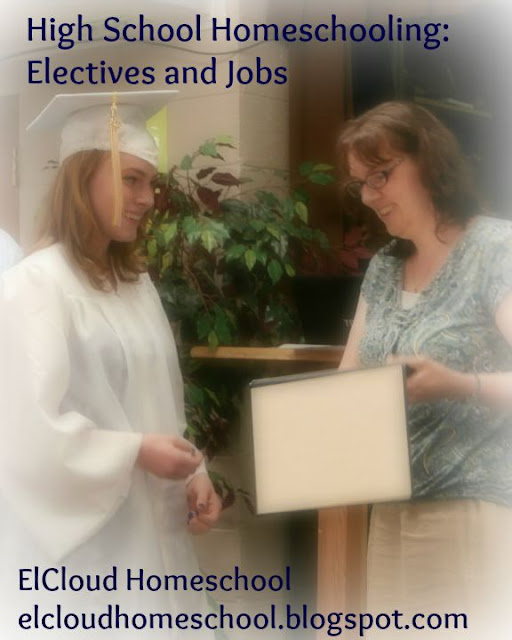
High School Homeschooling: Electives and Jobs

High School Homeschool Electives and Jobs - ElCloud Homeschool Blog

High School Electives

Each of my children have chosen different electives for their homeschool high school career. We have decided to require certain subjects for our students, similar to the public schools, so that only leaves space for 1 or 2 electives each year. Their electives have reflected their interests. We are open to creative choices for electives, but we have not listed Life Skills as code for housework on our transcript. We want their transcript to be strong and helpful for entering college, if they choose to. We aren't just looking for easy filler electives.

Some of the electives we've included have been:
  • Ancient History
  • Art
  • Art History
  • Church History
  • Choir
  • Computer Programming
  • Fitness 2
  • Latin 
  • Medieval History
  • Music
  • Photography
  • Psychology
  • a fourth math
  • a 3rd science (Classical Astronomy, Chemistry 2, Advanced Biology)
When we're working toward planning an elective, we use a few different methods. For some of these subjects, I have a textbook or a series of books that can be used to study the subject. If we are using books that don't have tests included, I require writing assignments, final projects, or have written final exams myself in order to give them a grade. We don't count hours with this method, but require the books are read and then grade the tests or projects they complete to show their understanding and application of the information.

For some electives, we count number of hours spent on the subject. For instance, two of my daughters joined the community choir. But it only met once a week, plus some weekend concerts. One year of that wasn't enough for a credit. When they also joined the church worship team, it helped fill in hours. But they still sang in the community choir for more than a year in order to earn the one credit of choir. That was also true for my oldest daughter's Music credit, we counted her hours spent practicing guitar and piano and assigned a credit accordingly.

We also used the hours method for Fitness 1 and 2. We made a plan of acceptable activities that would count for fitness: workout DVDs, running, bike riding, playing sports. Then we required that they put in 45 minutes five times a week to earn their credit, or 4.5 hours per week, divided as they saw fit. We figured that most school P.E. sessions are 50-60 minutes long, but part of that time is taken with changing clothes, attendance, and instructions, so we settled on 45 minutes for our class length. Two of our daughters preferred using Jillian Michaels workouts for their P.E. class. One preferred using aerobic walking DVDs and bike riding. We have also included yoga and pilates in their fitness instruction. My son will be in 9th grade this year and he plans to use more kickboxing style workouts. I will also see what we can do to gain access to some weights for him.

I am sure that our list of electives will continue to grow as our students continue to enter high school. We haven't yet entered into the realm of hands-on or mechanical electives, but if one of our sons decides to fix up an old car then Auto Maintenance and Repair may enter our list of electives, counting hours and mastery for figuring their grade and credit. If the car runs, the skill was learned, right?

Work Study and Jobs

All of our high school students have also held jobs, though we haven't added that to their school transcripts. If they were working skilled jobs where they were apprenticing with someone else, or even working as a farm hand, we might consider adding it as work study for at least one year of school. So far that hasn't been our situation.

We do want them to work for several reasons:
  • to earn their own spending money as we don't do allowances
  • learning a good work ethic
  • learning to manage their time
  • learning to interact with others in our community
  • learning to budget and make decisions regarding saving and spending
  • saving up to buy their own car, laptop, etc.
  • practice for working through college
  • begin building their resume and experience for after graduation

We started with our oldest daughter working 7-10 hours each week as a library page. That job suited her well and was a blessing as others in our community had not yet been willing to hire a homeschooled teen. (The downside of a small community with few homeschoolers.) It provided her with some spending and gas money, though not a large savings. She continues to work while attending college and has worked full-time during summer and winter breaks to help pay for her college tuition.

The next daughter started with that same library job after our oldest left for college, but also added in dishwashing at a restaurant on weekend evenings. She then left the library and became a Sonic Carhop, working more like 20-30 hours per week. We required that she keep her grades up or cut back her hours. She's a college student now, and still working at Sonic, almost full-time. She has managed to save enough to buy herself a used car and is also living on her own.

Our current 9th and 11th grade students both work at the same restaurant on weekend evenings only. They'd like to add in other work, but it's difficult since we live in the country and they are not yet driving on their own. We have learned that jobs with longer work shifts, fewer times per week, are better for us than an hour or two each day, when you factor in the cost of gas and driving into town.
When our 11th grade daughter earns her driver's license this fall, she will probably look for another job, either as a replacement or for additional hours.

Shaping their Future

Each student, each family, each homeschool, each community is different. Every transcript and high school experience will be unique. But if you pray, seek out the opportunities available to you, and think creatively, you can successfully fill your student's transcript and future resume with good training and experience. Just remember that these electives, and any jobs they hold, are helping to shape their future.

Talk to your high school student, hear their heart, look at their skills, invest in their interests, and you will create a rich high school experience for them. Enjoy this time, as you watch them develop into a responsible, productive adult.


Homeschooling High School Blog Hop 2015

Read More on Electives in the High School Years


April E.

Sunday, July 5, 2015

How to homeschool on a tight budget ...


Working with a Tight Homeschool Budget

Originally published on October 21, 2010. Still relevant today.

I recently ran across a question online, asking how families living on one income make ends meet while homeschooling.  I thought I'd bring my response here to my blog, as well.


There are several different ways that our family manages the expense of curriculum in homeschooling:
  1. We buy used curriculum as much as possible.
  2. We try to use library resources (even inter-library loan) before resorting to buying something.
  3. We use unit studies to combine subjects and students.
  4. We buy multi-level items we can use for more than one grade whenever possible.
  5. We buy non-consumable curriculum.
  6. We look for free resources online.

Exceptions: Math (K-4th grades), handwriting (K-6th grade), and Grammar (5th+ grades) are consumable workbooks.

There are also things you can do to eliminate over-spending on curriculum or making costly curriculum mistakes:
  1. Don't rush out and buy the "latest and greatest" new product.  Think, pray, wait!   You may realize that your current curriculum is working just fine, or you might begin to hear negative reviews that show it isn't the answer for your family after all.  If you do still want it, it will make its way to the used market pretty soon.
  2. Look for ways you can adapt your current curriculum before you try something new.  What appeals to you in the other curriculum?  Can you make your current curriculum more like that?

There are even more ways we try to save money in other areas of our life, so I can stay home and homeschool our children:
  1. We shop yard sales and thrift stores first.
  2. We don't buy new unless we can't find it used.
  3. We try to make do with what we already have.
  4. We try to do it ourselves before paying someone else to do it.
  5. We shop grocery sales, buy generic brands, and use coupons.
  6. We cook from what is in the pantry, or what's on sale, instead of shopping to fit the menu plan even if it's not on sale.
  7. We look for inexpensive and free ways to entertain our family.
  8. We try not to watch too many commercials or read too many magazines which lead to discontentment.

And the greatest tip of all is to pray for creative solutions.   Often, God has shown me ways to solve my household  or curriculum problem with something I already own.

If you want to stay at home, or homeschool, pray about it.  If it's God's will for your family,  He will show you ways that you can make it work for your family, too.

What are some of your favorite tips for saving money, and affording to be a SAHM or homeschool mom?  What are your favorite tips for saving money on curriculum?


April E.

Click on over to the Schoolhouse Review Crew blog to see what others shared on this subject!

Wednesday, June 24, 2015

Homeschooling High School: Planning For High School


Homeschooling High School Blog Hop 2015


I was very nervous when my oldest daughter approached high school. I wasn't sure what subjects we should cover, or how to make a transcript. I asked questions online, searched the internet for homeschool transcript templates, and looked at our state's graduation requirements for an idea of what subjects were considered requirements in our state. Then I made a plan, using our core curriculum as a guideline. We relied on a 4 year history cycle and literature-based history learning at that time.

Two years later our second daughter was entering high school and decided that she wanted her high school education to be textbook-based and line up as closely as possible with what her friends were studying in public school. So I made a new plan, with new curriculum and new subject titles on our transcript.

Another two years went by and our third daughter entered high school. She wanted the freedom to study sciences and languages not offered in our local public school. Against her sisters' advice, she chose to study Astronomy and Latin and Ancient History. We made a new plan that allowed her to cover the state requirements as well as follow her own interests.

And now my fourth child is entering high school. He'll probably follow the path of my second daughter, with textbooks and a desire to mimic the public high school's plan. But we are replacing our history textbooks with ones that are simpler to plan, and have fewer components to use. Sweet and simple is the goal, because I want him to be independent and not get bogged down in planning, excess busywork, or trying to figure out how to put it all together.


Two Types of Planning

In our homeschool we have two types of planning. We have our overall "high school plan" which we actually put into a transcript template at the beginning of their freshman year. We are planning with the end in mind - graduation requirements and possible college entry. Some subjects fill in automatically, easily falling into place on the year plan. Then there are the elective slots where we might write in some options, though everything is subject to change as high school progresses. Every school year, we reassess the proposed transcript plan - finalize the upcoming year and tweak the plan for future years. Our goal is 6 credits per year, for a total of at least 24 credits.

Our basic "high school planning" looks something like this:

9th grade
English 1
Algebra 1
Biology (or astronomy if you're DD2)
Geography
Health and Nutrition
Elective (possibly PE)

10th grade
English 2
Geometry
Chemistry (or biology if you didn't take it yet)
World History
Elective (foreign language?)
Elective (computer science?)

11th grade
English 3
Algebra 2
Psychology - Other Science - Elective??
US History
Personal Finance/Other 1/2 credit elective
Elective (foreign language again?)

12th Grade
English 4
Government/Economics
Elective
Elective
Elective
Elective


We also have our weekly planning.

With our oldest daughter, I was filling in a weekly worksheet of assignments for her (and every younger student), which was time-consuming. My second daughter switched to textbooks and took this task upon herself in high school. She figured out the pace she'd need to keep to complete her textbooks in 36 weeks. She filled in her weekly charts and kept herself (mostly) on track. (They say doing math through the summer is good for you anyway, right?) Our third daughter has also learned to plan her own weeks. We look at her curriculum together at the start of the year and make an overall plan, and she fills in her weekly charts. She's done an even better job of staying on track, with only a few math lessons to finish in the month after school ended.

Part of the reason I switched to new, simpler textbooks for my upcoming son is so that the weekly planning won't be overwhelming. I wanted to have textbooks that had 32 - 36 chapters, which would make it simple to plan one chapter per week. I wanted them to have just a couple components, so he wasn't overwhelmed by 5 different books for one subject. In other words, I wanted books that were more homeschool-friendly. I think it will take more time to teach him to do his own weekly planning, and I am going to have to keep a close eye on his progress, but it really is easier on everyone if the high school student is in charge of that (with oversight).

This year I bought both my high school students this student planner to use for their weekly planning. I'm hoping it will work better for them than the blank charts I was printing out every week. And rather than getting lost (my son) or stuck into a folder at the end of each week (my daughter) it will all be bound together as a record of their year.

You can do it, too!
High school planning can FEEL overwhelming, but it doesn't have to be. Start with your basic skeleton. What does your state require? How many classes and credits do you want to tackle each year? Fill in the basic subjects. The rest of your slots are electives. You can look at state requirements and usually find a catalog of courses from a local high school online to get an idea of electives you can offer.

However, this is also where homeschooling allows you to follow your child's interest. If he plays guitar, you can have 4 years of music electives. If she is in gymnastics or dance, you have four years of PE. If your child is into computers, then find a programming course for him or her. If your child is interested in photography, a photography elective is perfect.

You don't have to have it all figured out their freshman year. Just keep an eye on the goal (graduation requirements) and adapt as you go. There will be elective slots that get filled in later. There may be changes. Maybe they  move Chemistry to their junior year and do an extra elective their sophomore year. Get your basic skeleton plan in place, knowing it's subject to change, and then focus on the upcoming year.

You can do it! High school isn't that scary. Get some good resources to encourage you, and talk to someone in your area who is already homeschooling through high school. I'm sure they'll be glad to help you figure it out!

See what these other bloggers have to say:

Meg from Adventures with Jude on Planning Your Homeschool High School

Chareen at Every Bed of Roses with thoughts on Planning to Homeschool through the High School Years

Debra over at Footprints in the Butter asks: You mean I have to PLAN our Homeschool High School?!?
Michele at Family, Faith and Fridays shares Here's the Plan

Lisa at Golden Grasses says Don't Panic! Homeshcooling High School Blog Hop

Debbie at Debbie's Homeschool Corner Planning Out a High School Program

Gena over at I Choose Joy! shares her The Top Tip for Planning Homeschool High School

Kym at Homeschool Coffee Break shares on Planning and Preparing for Success

Tess from Circling Through This Life shares on Planning the High School Years

Erica over at Be The One shares Planning and Record Keeping for High School

Jennifer from A Glimpse of Our Life on Planning For Homeschooling Highschool

Carol over at Home Sweet Life on Making A Plan

Wendy at Life at Rossmont shares thoughts on Planning for High School

Cristi from Through the Calm and Through the Storm shares on Making High School Plans

Dawn Oaks at Double O Farms shares Planning for the High School Years

Leah from As We Walk Along the Road shares her thoughts on Making Plans for Homeschooling Through High School

Laura from Day by Day in Our World shares Planning High School Classes for the Homeschool Parent


Take a deep breath and just jump into your skeleton 4-year plan. You can do it!

April E.


This post has been entered into The July issue of The Carnival of Homeschooling, at Home Spun Juggling.

Crew Round-Up: High School Reading List

CTCmath Review


Our fourth high school student will be starting 9th grade this fall. We will also have an 11th grade student this year, and we've graduated two daughters already. I've tried to gear our high school literature assignments toward each student and their interests. Some of my children enjoy heavier, classic literature, while others need high-interest books to hold their attention. I find it is easier to assign them books that suit them, rather than fight them about reading a book they hate.

Before I start listing books, I probably should state that we are a Christian family, however we do allow more freedom for our high school students in what they read (both assigned and unassigned) than some families. Just be aware that this is not the most conservative of reading lists.


High School Literature:

  • 1981 by George Orwell
  • A Scarlet Letter by Nathaniel Hawthorne
  • Animal Farm by George Orwell
  • Cry, The Beloved Country by Alan Paton
  • Emma by Jane Austen
  • Fahrenheit 451 by Ray Bradbury
  • Frankenstein by Mary Shelley
  • Grapes of Wrath by John Steinbeck
  • Hiding Place by Corrie Ten Boom 
  • The Hobbit by J.R.R. Tolkien
  • Lord of the Flies by William Golding 
  • Lord of the Rings Trilogy by J.R.R. Tolkien
  • Murder on the Orient Express by Agatha Christie (and her other books)
  • Old Man and the Sea by Ernest Hemingway
  • Pride and Prejudice by Jane Austen 
  • Shakespeare's Plays (Merchant of Venice, Romeo and Juliet, Much Ado About Nothing)
  • The Strange Case of Dr. Jekyll and Mr. Hyde by Robert Louis Stevenson
  • To Kill A Mockingbird by Harper Lee
  • War of the Worlds by H.G. Wells

Advanced Reading List:
  • Great Expectations by Charles Dickens
  • Jane Eyre by Charlotte Bronte
  • Les Miserables (abridged) by Victor Hugo
  • Scarlet Pimpernel by Baroness Orczy  
  • Shakespeare's Plays (Hamlet, MacBeth, Julius Ceasar, etc.)
  • Wuthering Heights by Emily Bronte

Some of these books are ones I remember particularly enjoying in high school (To Kill A Mockingbird). Some of them were picked from reading lists (such as the 1000 Good Books List) because I thought my kids would enjoy them (Frankenstein), even though I hadn't read them in high school. And one of them is a book I hated in high school (Lord of the Flies), that I include because it opens up good discussion about morality and ethics and is a style they enjoy.

We often use Progeny Press or Total Language Plus study guides for our high school students. We have them select books at the start of the year and buy the guides from them. We're also willing to wing it, as we will be this upcoming year for my 11th grade daughter who will be studying Shakespeare's works. I prefer buying Progeny Press guides on CD-rom so I can re-print them for future children, but the kids enjoy the Total Language Plus guides a bit more. We try to use some of both brands each year.

For freshmen, I've settled primarily on books that I read in 9th grade because they were higher-interest books. A couple of them are classic dystopian and since my teens are enjoying modern dystopian books, I wanted them to be able to compare them. We start 9th grade with Fahrenheit 451, Lord of the Flies, To Kill A Mockingbird, and usually Old Man and the Sea because it's short. This year, my oldest son J will enter high school. He's a challenge to push through literature assignments, so we'll need his books to be high-interest and manageable in length. I think these four will work for him, though. I'll probably stagger them so that To Kill A Mockingbird falls between the two dystopian books.

My daughter C will be a junior this year. Her plan is to read as many of Shakespeare's plays as she can. I own a complete set now, and she's an avid reader. I also purchased a book about Shakespeare himself to go along with this plan, and she will be writing a variety of essays and research papers. I need to start compiling my list of essay ideas for the different plays. (Google to the rescue.)  I'm not highly concerned about finding literary analysis questions for each section. She talks through everything she reads with me, so we'll discuss it naturally. She's also put in two years of literary analysis work (which she hates) and she'll read more Shakespeare in one year than most high school students do in four years if I let her just plow through at her rapid reading rate, instead of slow her down with excess literary analysis. My main goal is to improve her writing skills this year.

There is so much room for freedom in High School Literature and in personal reading. We prefer to allow our children some room to explore different ideas and writing styles in this age - while they are still home to discuss them with us. Parents of teens need to make it a priority to discuss the books and the worldviews they contain with their teens - movies, too. If you haven't read the literature book yourself, consider reading along with your student (get two copies). When our teens pick up books at the library, we try to be available to listen to them talk about the book and point out worldviews and belief systems coming out in the books. They've been good about staying away from vulgar books or those that are overtly anti-Christian, but their fantasy and dystopian genres are tricky, gray-area books at times.

I hope this helps you think about your own High School Reading List. Stop by the Schoolhouse Crew blog to see more high school reading lists from other Crew members.

April E.

Thursday, May 21, 2015

ElCloud Graduation 2015: Take Two!

ElCloud Homeschool Graduation 2015


We had our second homeschool graduation this past Saturday. We've learned a few things since our first graduation ceremony.  We held the graduation in our church's fellowship hall again, which also doubles as a children's ministry area. We tried to remove some of the ministry decor, but we decorated around the rest of it.

(Quick confession: I only took about half these photos. My sister and my sister-in-law took the rest of them. We arrived with a dead camera battery, and we were also rather busy. A friend also took pictures of the people who were there, and we are thankful he shared them with us.)

This year, we skipped the rectangular tables and the rows of chairs which were supposed to separate the graduation ceremony area from the reception area. Instead we set up 12 round tables. (Well, actually we had help from church family to set up those tables. Thank you!) Our daughter and a friend planned out our table decorations which included framed quotes and a candle on some tables, framed senior pics and a candle on other tables, and balloon bouquets and a candle on the remaining tables.


I had bought a journal to double as a guest book and a graduation gift for 18 yo R. But she had the idea to buy these large paper letters from Hobby Lobby and paint them, then have the guests sign them. She plans to hang them on her bedroom wall. We also had the guests address their own thank you envelopes again, but this time we used a little yellow chalkboard to explain the process. She also had wallet-sized senior photos setting on this table for guests to take with them.


We learned we didn't need 2 large sheet cakes and 4 smaller cakes this time! (Go ahead, laugh at us.) We were planning on 2 large sheet cakes but then I found a graduation-cap shaped cake pan I wanted to use, as well. We only used half of each large sheet cake and didn't touch the graduation cap cake at all.


You might have guessed by now that our homeschool colors are blue and gold. There was a lot of blue and gold in the room. We also used the diploma style napkin scrolls wrapped around forks again. I'm not sure if we'll do that for future graduations. It's cute, but seems unnecessary in the end.

In addition to cake, my daughter wanted to have a cereal bar. We had four types of cereal and pitchers of milk on the table for guests. We also over-bought on cereal. But the kids will eat it all. No worries, there!


On our second refreshment table, we had mini-cheesecake bites, cheese and crackers, mixed nuts, and also an assortment of fruits and fruit dip. Our punch was blue (easy blue punch recipe) and we also had lemonade in another punch bowl for a bit of yellow at the table. In this picture, we hadn't mixed the blue punch yet.


Our "Honor the Grad" table included framed baby photos and senior photos once again. This time, instead of a yellow roses, R had selected some artificial flowers at Hobby Lobby for a blue and yellow bouquet. She has them in her room now.  She included some Dr. Suess block quotes from "Oh, The Places You'll Go!" and also her Up-inspired artwork she received for Christmas.  We had a baby scrapbook and her diploma laying on the table, as well.


To be completely honest, while I was at home trying to get cakes baked and decorated with Steve on Friday, R was setting up most of the reception area herself. When we arrived Saturday morning, we had some last-minute things like balloons to take care of, hanging the glitter "Congrats Grad" Banner we made 2 years ago and setting out food.

This time, we came prepared with a lunch plan for the family members helping us set up. But we still had to make a Wal-Mart run for some forgotten items, including PB&J for those who didn't like the BBQ shredded pork loin we'd brought. Next time, we need to figure out how to have the cheese and fruit pre-sliced if we do that again. And once again, we didn't have someone at the cake table when we finished the ceremony, and our family was all at the other end of the room.

Speaking of the actual graduation ceremony, this time we went with a very short, simple, relaxed ceremony at the very beginning. Steve welcomed everyone and gave his speech, then I had a short one for our daughter, as well. After that, Steve presented her diploma to her, and we moved on to the party. That is what R wanted for her graduation. She created a play list of music and a slideshow of pictures that played throughout the reception, but weren't shown during the actual graduation. It was a good day, though I'm thinking that 3 hours is about an hour too long for the reception.


What will we consider doing differently next time? We'll shorten the reception time, and have half the amount of food. Though we could probably get by with only one large sheet cake, I'm sure we'll have two cakes, although one may be the smaller graduation cap again. Speaking of cakes, my brother-in-law saved the day on one cake that fell apart coming out of the pan, and also on making the frosting perfectly smooth and easy to decorate on. I need to practice that smooth surface before the next graduation.

I'm learning that every graduation we do will be very different. C should graduate in two years and she's not sure she wants a blue and gold party. We'll have to see how she feels in 2 years. J has about 4 years to go and he's not sure he wants a party at all. I expect his will be very low-key. But that's fine. I want each celebration to be a reflection of that child's individual interests and personality.

This week, I went with R to college enrollment for next year. She plans to major in Business Administration. She's already starting her adventure!

(this picture courtesy of B. Steffen)

Good luck to our 2015 Graduate!
April E.


This post has been entered into The July issue of The Carnival of Homeschooling, at Home Spun Juggling.

Tuesday, April 7, 2015

Homeschooling and Doubts

I've been homeschooling for 15 years. I have one graduate and another graduating next month. I have homeschooled boys and girls, all grades and ages. We've used unit studies, classical curriculum, textbooks, and have even relaxed/delight-directed school some years. We've homeschooled through pregnancies, surgeries, a move, dealing with Steve's parents' health problems, and family deaths.

You'd think we were experts by now. But I still have doubts.

I still wonder if I'm doing a good job. I still wonder if my kids are going to be successful. I wonder what gap is going to appear one day and cause a little glitch in their life. I wonder if they're going to hate me for homeschooling them. I wonder if laws are going to change and make it harder for the younger ones to get into college someday.

I worry about getting my boys through the high school years on track and without too much conflict. I worry about whether we should change curriculum again. I worry about making sure each child gets enough extra-curricular activity for their interests. I worry about affording the curriculum I think we need to try next year to motivate that son. I worry about what people think of me, and our kids.

I think every homeschool parent wonders, "Am I doing the right thing? Am I doing a good job?" That isn't a bad thing. It helps us to re-evaluate why we're homeschooling and if the reasons still apply for our family. It also helps us take an honest look at areas where we may need to improve. For instance, I know I need to focus on writing more with my kids, especially my boys. I also need a better system for accountability and checking in their work.

For our family, the main reason we homeschool is to be able to provide a Christian education with a Biblical worldview. That need hasn't changed. We know there are some great Christian teachers in our school system here, and we respect them. But we also want to use a Christian curriculum, so we continue to homeschool.

Okay, so I'm doing the right thing ... but am I doing a good job? It helps me calm my doubts when I look at my older children. My oldest daughter is a sophomore in college. She is on the honor roll. She's responsible and gets herself to class on time (most of the time). She has friends and is respected by her peers and her professors. I guess homeschooling, even with my faults, worked out okay.

My second daughter is a senior in high school, but she has taken all her classes at the community college this year, dual-entry. She's also thrived in that setting and is getting great grades. She's a hard worker and respected at both her jobs. I know she'll be successful in life. At this point, she swears she will never homeschool her kids, but that's fine. I was faithful to my conviction and she will have her own life decisions to make. I don't expect my children to be just like me. I don't expect them all to have large families and homeschool.

Doubts and fears are normal.
When they start to overwhelm you, use them to evaluate how you are doing. Look at the situation objectively, evaluating your children's strengths and weaknesses. Ask yourself how your children are doing in other settings: do they keep up in Sunday School, are they reading at the right age, are they well-behaved, able to get along with others? How do other adults view your children? Especially, ask your husband what he thinks. Make a list of what you're doing well. Make a list of things to improve. Journal about why you homeschool.

Most of the time you will be reassured that you're doing just fine, your children are learning and growing. Sometimes you will have to face some areas that need work. That's good, too. Don't be discouraged. Accept the challenge and make some changes.

You can do this homeschool thing! Don't stuff your doubts in the back of your mind to keep nagging at you. Pull them out, examine them, and throw them out. Get a good night's sleep, and then get busy again! You've got too much to do to let those doubts drag you down. When they sneak back in, just read your lists again and be reassured. You're doing a great job!

April E.

Discover real life in other homeschools with the Schoolhouse Review Crew bloggers! Join the blog hop to read more!

Real Life Homeschool Blog Hop

Meet a few of the Real Life Homeschool Bloggers:
For This Season
Unexpected Homeschool
For Him and My Family
As We Walk Along the Road
Growing in His Glory
Homeschool Coffee Break
Daily Life
There Will Be A $5 Charge For Whining
Proverbial Homemaker

Thursday, August 7, 2014

Can you homeschool high school?


That was the title of this week's The Homeschool Minute e-mail from The Old Schoolhouse Magazine. (You can read this encouraging free email HERE.)  When I saw the question though, my first thought was:
"Yes, you can! But it won't always be fun or easy."

I've now graduated one daughter from our homeschool high school and I have another homeschool senior this year.  I also have a homeschool sophomore and an 8th grader waiting to enter our high school next year. Our journey through high school hasn't always been a smooth one, but I've learned a few things along the way.

Ten Things I've Learned About Homeschooling Through High School

1. Listen to your teens and their learning preferences.  Don't keep forcing your own preferred homeschool style on them if it's just going to create more stress for them or more tension between you both.  For me, that meant giving up my literature-based unit study approach and moving to textbooks.  It also meant allowing two of my daughters to gear their subjects to align more closely with what their public school friends were learning, even though I wanted them to have the freedom to diverge from that. My oldest daughter wishes I'd made the switch sooner, but she was our guinea pig.

2. Set firm deadlines.  I am not good at this.  I don't want too much tension and I hate confrontation.  I'm also too merciful (though my kids would disagree with that.)  Because of my weakness in this area, our teens have often fallen behind in their school work.  We've tried to correct that by having our seniors take a course or two at the community college their senior year, to get used to deadlines and class room settings.  It has worked, but it's an expensive solution.

3. Prepare yourself mentally for conflict.  I'm sorry to tell you this, but if you have strong-willed, independent children (as I do) there will be conflict in homeschooling, especially as they grow older. Homeschooling does not prevent all drama and conflict in the teen years.  You may be accused of ruining their life, especially their social life. There will likely be arguments, and even tears. Expecting that will help you deal with it calmly.  Do not take everything they say personally.  My oldest daughter actually thanked me for homeschooling her after she left for college.  I didn't expect that so soon, but it meant so much to me.

4. Remind yourself OFTEN of why you homeschool.  You will be tempted to send them to school.  Accept that.  They will complain about all they're missing out on: drama, band, prom, dances, football and other sports.  Sometimes they complain subtly and sometimes vehemently.  You will doubt whether you're really making the best choices or if you're ruining them (as they claim you are).  You have to KNOW why you're homeschooling, and be in unity with your spouse.

5. Keep good records, and backups of the records.  While it isn't necessary to have quarterly report cards, it helps to tally their grades in each class throughout the year and record them.  I've kept a running transcript since my oldest daughter's freshman year.  Earlier this year, I discovered one fault with my system.  It was all on my computer.  When my computer crashed, I didn't have a backup, other than the last print-out I gave to my daughter in the Spring.  I need to re-create the file now, for each of my high school daughters, and unless my files can be retrieved, I don't have a copy of my oldest daughter's final transcript.  The only hard copy is at her college. (I'm still praying my husband can save my computer's data ... it has lots of helpful e-books and software on it, too.)

6. Teach your children to do their own weekly planning.  At the start of each new textbook, my teens and I sit and look at how many chapters the book has.  We then decide if they need to do one chapter per week, week and a half, or every two weeks.  They then have  a plan to follow, and they fill in their weekly planning charts for what they need to accomplish in each subject.  I check in with them periodically, and they come to me with questions, but they are largely self-directing.  When I don't check in with them often enough, they sometimes fail to keep up in the less fun subjects.  That is my fault, in the long run.

7. Let them pick their subjects. If one child wants to study astronomy and the other one wants to take Anatomy and Physiology, let them. (If you can find a curriculum for it, that is.) They will do better when they get to pick something that interests them. Sometimes they'll realize they made a mistake, as my daughter did with Chemistry 2, but usually they'll enjoy the class more. We also use Total Language Plus and Progeny Press for English courses.  I let them pick what books they want to study each year.  If they end up disliking the book, they know they picked it ... and it wasn't forced on them.

8. Work with your child to set guidelines for electronic devices and other personal distractions. We try to talk with our kids, and ask them what they think a reasonable set of rules and guidelines will be.  We reach an agreement, which we usually sign, and then we can refer back to it when we need to remind them they're letting themselves be distracted too much. Those distractions could include social media, movies, gaming systems, or even just time spent with friends.

9. Be willing to help them find answers, and resources, that will help them succeed.  Sometimes that just means doing some research with them.  Sometimes it means finding supplemental materials to purchase.  We have always attempted to homeschool as inexpensively as possible.  That has been less possible in high school. We have had to buy more curriculum for the high school years than we ever did in the elementary and junior high years.  As our collection of high school materials grows, that will be less of an issue for future years.

10. Help them think about their future.  Not only are you their teacher, you're also their guidance counselor.  What are they working towards?  What goal do they have in mind? If it's the military, college, or a future career ... remind them of that when they are dragging their feet about their work. And they will drag their feet sometimes.  I am actually nervous about my son starting high school next year.  He'll be the first boy in our high school, and I'm not sure yet how I'm going to keep him motivated.

BONUS:  Don't isolate your teens. For us, we needed to allow our teens to have time with friends and interaction with the community as a whole.  Each of our teens has had a job outside the home and been allowed to spend time with friends from church or homeschool group, and others they met through those friends.  We didn't want them to feel completely alone or rejected.  We also wanted them to have the experience, responsibility and independence that working would give them. This has actually been vital to their emotional well-being, though it wasn't without issues at times.

Yes, you can homeschool through high school. 

It is a big commitment of energy, time, and finances. It has been a learning process for me, much like when I started homeschooling, but it has been a good experience. Handing my daughter her diploma at her graduation ceremony made it all worthwhile, and watching her succeed in college is such a blessing. 

Research, talk to other parents, talk to your spouse and your kids, and be ready to make changes as needed. Pray, rely on God's strength, and jump in!  You can do it!

April E.

Friday, February 21, 2014

Planting seeds of hope in the middle of winter

This is the time of year when we are all just done with winter. The cold, the gray, the snow, the slush, the mess ... the gray. A few warm, sunny days come along and bring hope of Spring, only to be followed by another snowstorm that no one wants.


If you're a gardener, this is the time you pull out your seed catalogs and start planning what flowers and vegetables you're going to plant this year.  Will it be sunny daffodils, glorious iris, luscious cantaloupes, or healthy salad greens? You can almost feel the sun on your back as you plant the seeds, weed, and harvest the fruits of your work.  Hope returns.


If you're a homesteader, you might start perusing hatchery websites trying to decide what new chickens you're going to add to your flock this year.  You can almost hear their cheeps and feel their soft fluffiness.  You can see them hovering under the warming lamp and scattering as you reach in to fill their feeder.  You can imagine them clucking away in the sunshine, nipping at seeds and bugs, and the eggs you will collect.  Hope returns.


If you're a homeschool parent, struggling to survive cabin fever and mid-winter blahs, trying to motivate children who are just sick of school ... you start to re-evaluate your curriculum. Is this a problem that new curriculum will fix, or is it more of a character issue you need to work through? Do you already have another option stacked up somewhere? Do you need to adapt what you already have? What are your friends using? The hope of something new and shiny to fix all your homeschool problems rises within you.


I know that all of those are true for me, but especially the homeschool one. I start daydreaming about next year's curriculum. I make a list of each student I'm going to have and their grades.  I make a list of what curriculum I want to use with them.  List after list fills my notebook: what I own, what I need, what I want, what I can make do with.


And somewhere in all that daydreaming and planning, I find my vision renewed and myself re-energized.  I am ready to push through the final dull days of winter, the spring fever distractions, and the kids who just want to skip ahead to summer vacation. I have a plan, and a goal. 

What about you?  What gives you hope in the dark, dull days of winter?

April E.

Thursday, February 6, 2014

I'm thinking about homeschooling. Where do I start?


Over the years I've had several different people ask me about homeschooling and where to begin.  Some of them were pulling their kids out of public school, and some were starting at the beginning.

Unfortunately, some of my favorite resources and websites have disappeared, and I've had to come up with new lists in recent years.  I know there are other "getting started" lists and websites available, but I still thought I'd put together my own list of  steps for starting homeschooling, helpful websites, and my favorite books.


KNOW THE LAW
The first step to getting started with homeschooling is to know your state's laws. Do you need to register? Are you required to use an umbrella school? Do you need to file every year, turn in reports, test annually? Get the legal stuff out of the way before you start homeschooling so you won't have to worry later.

We are in Kansas, and if you're also from Kansas, this website will help you get started as well as register your homeschool with the state: http://www.kansashomeschool.org/

HSLDA provides legal information and protection to members, but their website also includes helpful information for non-members.  You can look up your state laws and requirements here - http://www.hslda.org/hs/default.asp   

HSLDA also has created a new website called You Can Homeschool that has helpful information about homeschooling.   There is also information on their own website still: 
  - http://www.hslda.org/LandingPages/teaching-my-kids.asp
  - http://www.hslda.org/earlyyears/StartHere.asp


IDENTIFY YOUR HOMESCHOOL STYLE
There are several different websites that have been compiled to help you figure out what educational method and curriculum type you want to use.

My favorite resource used to be the Elijah Company catalog, and when they went out of business I kept one of their catalogs for the longest time.  If you can find one of these, the beginning pages are full of wonderful information.  In the meantime, the owners of the Elijah Company do have another website which is also very helpful.  Check out this getting started guide, as well as the links in the left sidebar:   http://www.homeschoolmarketplace.com/choosing/index.html
 

Home Educating Family Magazine has a helpful How To Homeschool page on their website.

This website also has information on different homeschool approaches. http://www.homeschool.com/Approaches/


FIND YOUR CURRICULUM
Often discovering your homeschool style will naturally point you in a direction for curriculum. Sometimes, though, we can't afford what seems to be the obvious choice, or we don't find a perfect fit for our family. In that case, you need to start looking elsewhere. Ask other homeschool families for suggestions, and check out these websites:

  • Homeschool Mosaics has a wonderful list of free resources online - http://homeschoolmosaics.com/homeschooling-for-free/   
  • Rainbow Resource is a huge catalog of homeschool curriculum, supplements, books, and other resources.  Request their mega-print-catalog, but don't let it overwhelm you.  
  • Christianbook.com sells many homeschool curriculums, and their website is easier to search than Rainbow Resource.   
  • Homeschool Classifieds is just one of several websites where you can purchase used materials.  Be wise, but most people are honest.
  • Cathy Duffy is well-known for her curriculum reviews, authoring several books and this helpful website. 


MAKE A PLAN
It doesn't have to be complicated, but you do need to have a bit of a plan for getting started with homeschooling.  Will you school 4 days a week?  5 days a week?  Will you school year-round?  Will you work with your kids as a group, or try to teach them each one-on-one?

These websites have some helpful steps for getting started and planning out your school year, or at least your first month:


FIND A MENTOR OR SUPPORT GROUP
You don't need to plug into a homeschool co-op or classes right away, but you do need to find some support.  Whether you reach out to other homeschool moms in your community or connect with an online community, you're going to need to find a group where you can ask questions, share your struggles ... and most importantly, be encouraged.

You can do an online search for local homeschool groups, or start asking around.  Some groups are small and may not make it onto an online list, though someone should be able to point you in the right direction if you ask locally or online. 

Once you've found your curriculum of choice, or homeschool style, there are also online communities for other homeschool families using that curriculum.  These are very helpful since they're using the same materials you are or share a similar educational or religious philosophy.


HELPFUL BOOKS AND RESOURCES
Books
  • The Ultimate Guide to Homeschooling by Debra Bell
  • Homeschooling for the Rest of Us by Sonya Haskins
  • Things We Wish We'd Known  by Diana Waring
  • Beyond Survival by Diana Waring
  • Educating the Whole-Hearted Child by Clay and Sally Clarkson 
  • Charlotte Mason Companion by Karen Andreola
  • Homeschooling on a Shoestring by Melissa Morgan
  • 101 Top Picks For Homeschool Curriculum by Cathy Duffy (or any of her other curriculum review books)

Magazines - many of these offer a free sample so you can decide if you want to order a subscription.


FINAL ADVICE FOR GETTING STARTED
Relax.  Don't panic!  You can do this.

Start gently and just focus on the basic subjects at first.  Do math every day, phonics, language arts, and handwriting.  If you don't have a science or history curriculum at first, you can find books at the library to read about science or history.

Become friends with your library, learn to use their inter-library loan system.  Read, a lot.  Read books to inspire yourself.  Read aloud to your kids.  Encourage them to read.

Remember, you can always add on more subjects and supplements as you find your groove and become comfortable with homeschooling.

Talk with your husband, talk with your children, and pray!  Homeschooling isn't easy, but it's also not as hard as you think.


God bless, and good luck!
April E.


This post has been entered into The July issue of The Carnival of Homeschooling, at Home Spun Juggling.

Thursday, November 14, 2013

What does homeschooling look like? Then and now.


The other day my daughter told me someone asked her what homeschooling was like.  They wondered if I sat and lectured the kids and she told them that no, they teach themselves from textbooks and get help when they need it.  While that is true, now, it's not how it's always been.  I reminded her of that, and then I started thinking about the changes in our homeschool over the years.

We've basically had four different stages of homeschooling in our family.  When people ask me about how our homeschool day works, I tell them what it's like now.  Even I forget that it was different when we only had young kids, close in age.  We taught differently then, and we used different curriculum.


Stage 1 - Homeschooling two small girls:
When we first started homeschooling, we had two students, close in age.  We sat at the kitchen table and they both did handwriting and math at the same time, in their own age-appropriate workbooks.  I sat there holding the baby and moved between them, helping them as needed.  Sometimes I cooked lunch or did dishes nearby.  When the workbooks were done, and the baby was napping (hopefully), we'd sit together at the couch and read a book from our Five In A Row unit study.  We talked about the lessons, looked up information in other books, and found places on our globe or wall maps.  Then my older daughter would read from her Christian Liberty Nature Reader and I'd take the younger one to my bedroom to do her phonics lesson. 

After that, they were free to play, read, watch educational tv, build with legos, etc.  They played ALL afternoon.  The house was trashed with their creative play as toys moved all over the house in their imaginary world.  We'd try to clean up before supper, before Daddy got home.  Sometimes we didn't get it cleaned up until after supper, after Daddy had seen their creative mess.  At that point, education was very much centered around Mommy.  We were relaxed, conversational, and literature-based in our methods.


Stage 2 - Homeschooling four young children:
Things got a little more hectic when I had four children in elementary school.  We still did our math and handwriting at the table but there were more people working together, more distractions, more need for me to be right there with them.

I was trying to work two different levels of Five In A Row.  I had two young kids using a mix of Before Five In A Row and Five In A Row.  I also had two older girls using Beyond Five In A Row and usually sitting in again for Five In A Row.  While the baby played on the floor, I had a preschool/kindergarten boy doing a few workbooks, lots of puzzles, and lots of legos.  I was continually trying to find a quiet moment to get the struggling-reader alone for some more phonics practice.  Then when I needed to do Beyond Five In A Row with the older two girls, we would sneak into a bedroom and hope the other three kids would be happy for us.  Many of those lessons were interrupted by younger children.

It was hard, and I always felt as if we were falling behind.  In reality, we were doing a good job, but it wasn't easy.  Education was still very mom-centric, conversational, and literature-based ... but it was getting harder to manage with the different age levels and larger family.  Kids often played in breaks between working with Mom, so play and school were both intermingled through our day and every day looked completely different from the last one.


Stage 3 - Homeschooling Kindergarten through Junior High:
It was at this point that we decided we needed a change. My oldest daughter was approaching junior high and I was seeing that soon I'd need to teach 3 different levels of unit studies.  I couldn't do it.  It stressed me out to think about it.  So we switched to Tapestry of Grace.

With Tapestry of Grace, all the children studied the same period of history using living books at their age-level.  I used the library to find the recommended books and substituted books when I couldn't find a specific one. I read books aloud to the younger children and the older ones read to themselves.  We used more non-fiction books at this point, and less literature, and we missed the more relaxed conversational story-time that Five In A Row was.  But I loved that we were all studying the same thing.

Sometimes at lunch or supper, the kids talked about things they learned in their different books, and they were eager to share things with Daddy.  It meant more preparation by me of finding the books, filling in assignment sheets for the kids, but it made the daily work of homeschooling more manageable.

Homeschooling was somewhat mom-centric, but older students moved toward more independent work.  They read their own history books, and their own math and science lessons to themselves from textbooks that taught TO the student, and sought me for help when they were confused.  We became less relaxed, but still enjoyed learning from as many living books as possible.


Stage 4 - Homeschooling all grades, K-12:
It was when my oldest daughter entered high school that Tapestry of Grace began to break down for us.  For our family, who was still relying on the library for a large portion of the books, we found it hard to find the correct books in our rural library system.  Substituting books didn't work as well for the lesson plans at the high school level and some of the books were just too difficult, even for my advanced reader.  (I should clarify that we were using the Classic TOG plan, not the redesigned plan. The book issue isn't as difficult if you purchase them all, but we couldn't do that.) 

When my second daughter entered high school, she told me she didn't want to use Tapestry of Grace, but wanted to switch to textbooks.  She had never enjoyed reading as much as her older sister and she saw how overwhelmed her sister was with reading.  She didn't want that.  She also wanted to have more "regular" course titles that lined up better with the public school courses.  While I didn't agree with that particular reasoning, I didn't want her to hate her curriculum, so we switched.  As she began to use separate textbooks for history and literature, her older sister decided to follow suit and abandon Tapestry of Grace. Thus began the fourth change in our homeschool.

At the moment, my youngest children use math and handwriting workbooks.  They do phonics one-on-one with me, and read the Nature Readers to themselves. They join in on the Tapestry of Grace studies, as interested.  We read together from lots of other books that interest them. They do more hands-on, relaxed, life-learning than the older kids. Education is still fairly mom-centric, but Mom doesn't feel the need to push this age as hard.  I miss using Five In A Row with them, but every time I try to return to it with the younger kids I fail to follow through.  It's too hard to get that daily FIAR time in and still manage the other school needs.

Once a child is reading well on their own, we add grammar workbooks, science textbooks, and Tapestry of Grace assignments to their math and handwriting books.  Over the years, I've come to follow TOG more loosely.  I look at its book suggestions but I often seek out more appealing books that cover the same time-period.  I have 3 students using Tapestry of Grace.  Two of them are boys, and some are reluctant readers. They all do better with something that is very engaging and interest-catching.  If I assign too much reading, they fall behind.  Every week is a balancing act to be sure that they are challenged, but not overwhelmed. Mom is the education planner and manager, but the goal is to move them toward independent work as much as possible.  Mom comes to help as needed, and some days this keeps me running back and forth, especially at the start of the year.

My high school students diverge from Tapestry of Grace and work very independently. They are using textbooks for all subjects at this point, and I have taught them to fill in their own weekly-planning charts, too.  At the start of the year we look at each textbook and figure out how much they need to cover each week to finish the book by the end of the year.  I help, as needed, and keep their grades.  There are two subjects they are studying that require more of me.  My junior is using Abeka Spanish and I have to sit and do review and conversation practice with her.  We've figured out how to do it in 3 lessons per week instead of 5 lessons, but often this happens late at night instead of during the day.  It's too hard to do that during the noisy, hectic day.  My freshman is using Classical Astronomy and sometimes has to do night-time observations ... for some reason, she doesn't want to sit outside in the dark listening to coyotes alone. Most of the time, though, they read and study on their own, and Steve and I help where needed, when they're stuck on a math problem, need help with a new concept, have an English question, or need help with a science experiment.

Homeschooling now looks completely different than it did when we started.  I am less involved in their daily lessons, but it's what we have to do to teach six students at once (preschool through high school.)  Instead of sitting together on the couch or at the kitchen table, we are scattered through the house.  We have one studying at a desk in his room, one studying at a desk in the kitchen, and two or three working at the table.  Sometimes the youngest student has to do her math on the floor beside me in order to stay focused.

Despite being spread out and mostly self-directed, we still try to be conversational.  We often discuss their history lessons, their literature books, or what they're learning in science.  They share with me, their Dad, or each other.  Some days, I spend a lot of time redirecting distracted kids who would rather socialize with each other or play.  Some days, less bookwork happens but important spiritual or life discussions happen.  But they are all learning and growing, and that is what matters.

April E.


This post has been entered into The July issue of The Carnival of Homeschooling, at Home Spun Juggling.