Showing posts with label Homeschool Crew Reviews. Show all posts

Monday, November 16, 2015

2015 Blue Ribbon Awards from the Schoolhouse Review Crew

The Schoolhouse Review Crew is wrapping up for 2015 and the Crew families have voted on their favorite products from this year.

Check out our Blue Ribbon Awards!


Favorite Reading Curriculum: Reading Kingdom
Favorite Writing Curriculum: Institute for Excellence in Writing
Favorite Vocabulary Program: Dynamic Literacy
Favorite Penmanship Program: CursiveLogic
Favorite Literature Curriculum: Progeny Press


Favorite History Curriculum: Home School in the Woods
Favorite Science Curriculum: Visual Learning Systems
Favorite Science Supplement: Ann McCallum Books: Eat Your Science Homework
Favorite Math Curriculum: CTC Math
Favorite Math Supplement: SimplyFun


Favorite Christian Education Curriculum: Grapevine Studies
Favorite Christian Education Supplement: Brinkman Adventures
Favorite Foreign Language Curriculum: Middlebury Interactive Language
Favorite Fine Arts Product: Maestro Classics
Favorite Elective Curriculum: Apologia Educational Ministries: Field Trip Journal
Favorite Audio Drama: Brinkman Adventures
Favorite Video: FishFlix.com


Favorite Preschool Product: La La Logic
Favorite Elementary Product: Star Toaster
Favorite Middle School Product: The Critical Thinking Co
Favorite High School Product: Writing with Sharon Watson
Favorite College or College-Prep Product: Freedom Project Education
Favorite Parent Product: Koru Naturals


Best Resource I Didn't Know I Needed: Homeschool Planet
Best Online Resource: Super Teacher Worksheets
Best e-Product: Home School in the Woods
Just for Fun: USAopoly
Kids' Choice: La La Logic
Teens' Choice: YWAM Publishing
All Around Crew Favorite: Institute for Excellence in Writing


That is my final post for the 2015 Schoolhouse Review Crew. I'll be taking 2016 off, so you will have to visit the Schoolhouse Review Crew blog to follow next year's reviews. It was a great year, but our family needs to regroup and get better organized before we apply again.

April E. 

Tuesday, November 10, 2015

Crew Review: Fun-Time Phonics from The Critical Thinking Co.


I have always been impressed with any curriculum we have used from The Critical Thinking Co. Always. When they appeared on the Schoolhouse Review Crew review list for a second time this year, I was happy to volunteer. We received a copy of Fun-Time Phonics to use with our children and review.


As with every Critical Thinking Co. product I've used, Fun-Time Phonics is a paperback workbook. It is 314 pages long, with 100 activities included. Some activities are several pages long, and should be broken into smaller segments with young readers. The book is full-sized, measuring 8.5 x 11 inches, and one inch thick.

Some workbooks from The Critical Thinking Co. are consumable, though most allow photocopying for family use. Fun-Time Phonics doesn't involve any writing. Every activity is completed by pointing, so this book is completely reusable and non-consumable.


Fun-Time Phonics uses colorful illustrations in all the activities. The pictures represent words that are listed for the parent at the bottom of the page, or along the outer edge of the page. This is a pre-reading workbook. There aren't any words to read in it until the final 13 pages. Though my son was using his reading skills to figure out some of the activities.

I first tested this with my 7 year old son, who has already learned the basics of reading. He can read 3 letter words easily and is gaining confidence in reading larger words. The beginning sections of the book were a breeze for him. He did struggle with the letter-switching activity where they replaced the middle vowel with a different vowel. He had never done that before. We also used Fun-Time Phonics to practice hearing different vowel sounds and identifying them. This is actually a skill he will need in learning to spell and write.

When I used it with my 4 year old pre-reading daughter, we started at the beginning and found it was more a fit for her. We moved slowly, working through the early pages. We soon had to stop, as she was not ready for the later activities. She may need more time to be ready for reading lessons, or she may need extra review.

I like the different way some of the activities approached phonics. The Critical Thinking Co. uses a comprehension approach in Fun-Time Phonics. The vowel-switching activity to create a new word was new and challenging for my son. The largest portion of the book has the child picking which image begins with a certain 2 letter combination.  (Which word begins with be_ ?) This was also a mind-stretching activity for my son. However, I can't stop using our reading curriculum with him, since he is basically beyond the scope of this book. Although using this does increase his understanding of the word-building process.

Although Fun-Time Phonics is intended to be a complete, stand-alone phonics curriculum, I am having a hard time trusting that it will work on its own. It is obviously a great supplemental resource for teaching phonics, but I don't think it can stand alone as a reading/phonics curriculum. At least, not for my children.

Fun-Time Phonics is available as a paperback book for $39.99, or as a Windows download for 2 computers for $19.99. If you want it for up to 6 computers, the price is also $39.99.

Don't forget to follow The Critical Thinking Co. on social media:

April E.


The Critical Thinking Company Review


Crew Disclaimer

Monday, November 9, 2015

Crew Review: Eat Your Science Homework from Ann McCallum Books


I had never heard of Ann McCallum Books before it appeared on the Schoolhouse Review Crew's list of upcoming review items. It was fun to poke around her website and see all the wonderful, educational books for children that she has written. In the end, I was glad we were chosen to review Eat Your Science Homework: Recipes for Inquiring Minds. We've used cooking to explore history before, but we'd never really used it for science before. Not to mention, I can always use some help finding hands-on ways to make science fun!


When Eat Your Science Homework arrived, the kids had fun flipping through it, looking at the six recipes and the science topics they explored. We had debates over which recipe to make first: Sedimentary Pizza Lasagna, Black Hole Swallow-Ups, Loop Whorl and Arch Cookies, Atomic Popcorn, or Invisible Ink Snack Pockets. No one was very interested in the Density Dressing and Veggie Sticks. I guess that sounded too healthy.

In the end the Invisible Ink Snack Pockets won for our first attempt at eating our science homework. I'm sure it's because the kids quickly realized it was basically a pizza pocket and they love pizza! I used store bought pizza crust dough because I was feeling a little lazy about making my own crust. The kids helped me fill each pocket. Our edges didn't seal very tight, but that didn't seem to matter -- for taste, or the experiment.


After we had filled the pockets and folded them shut, we mixed up our invisible ink paste. The directions for this were a little vague and I accidentally used a bit too much water. It only needs a LITTLE bit of water. We discovered that the kids needed to dip deeper into the thick paste and not the watery surface in order for it to show up. Our last pan turned out best, after two trial runs. When it cooked, the ink did show up. Do you see my TOS pocket in the front left corner?  The kids had fun labeling their pockets and then picking it out to eat afterwards.


Pizza is always good, right? But especially when you get to make it yourself and decorate the top of it. The kids did complain that the ink had a sweetness they could taste on their pocket. You might encourage your kids to keep their decorations light when they make theirs, and not to overdo it.


But how is that science, you might be wondering? Well, each recipe is introduced with a page that explains the science topic a little. In this case, the children learned about oxidation and the pH scale. They even learned a bit about ions, atoms, protons and electrons. In other words, it fit in perfectly with my 11 year old son's current Chemistry lessons!


Each recipe is concluded with a few more ways to explore the subject. We were given suggestions for different liquids to try as invisible inks on paper. We also learned the difference between chemical and physical reactions. As we talked about it, we also remembered the movie National Treasure and the scene where they're looking for invisible ink messages on the back of The Declaration of Independence. While that is a fictional movie, it brought up the fact that invisible inks were used historically ... just maybe not on The Declaration of Independence. It led to a fun discussion!

As you can see in the pictures, Eat Your Science Homework has colorful, cartoon illustrations by Leeza Hernandez. The illustrations help make the book fun, interesting, and inviting. It draws the children in, and gets them reading about each topic. It also gives them something to look at while you read aloud.

There are only 6 recipes in this book, but it can be used in many ways. You can use it as a resource to pull out when these topics arise in your science curriculum. You can use it for fun school days, if you like to have a Fun Friday once a month. You can use it for some educational fun during the summer, as well. I think that's my favorite, actually.

The book itself begins with an explanation of the Scientific Method, as well as safety tips for cooking in the kitchen. I like that she encourages them to experiment and develop a hypothesis after each recipe. The book ends with a two page review of the topics covered in the book, as well as a glossary of science vocabulary. The glossary can be used to prepare vocabulary quizzes or spelling tests, if you're really ambitious.

Eat Your Science Homework is a fun resource to add to your home library, whether you homeschool or like to explore science with your kids after school. The paperback version which we received is sold for $7.95 and the hardcover version is sold for $16.95. There are also two other books in the series: Eat Your Math Homework and Eat Your U.S. History Homework. You can read reviews about all three books at the Schoolhouse Review Crew website.


April E.


Ann McCallum Books Review


Crew Disclaimer

Wednesday, November 4, 2015

Crew Review: Brinkman Adventures, Season 3

Brinkman Adventures Season 3 Review

I had heard of The Brinkman Adventures before, but we hadn't made it a priority to purchase them. I was very excited to be chosen to review Brinkman Adventures Season 3.  Our family has enjoyed audio dramas before, but we haven't heard any missionary audio dramas before. We were missing out!

Brinkman Adventures Season 3 Review

At first, I was the only one excited about the CD set of season 3 when it arrived. We had these CD's for awhile but I couldn't convince the kids to listen to them. The kids expected them to be boring and didn't want to sit quietly to listen. One morning, I put the first CD in so I could start listening to them myself. Soon the children woke up. One by one they settled down and began listening. We finished the first CD in one setting, and the room was totally quiet the entire time. I hooked them!

The Brinkman Adventures are extremely well-made audio dramas. Our children are pretty much tv and video game addicted (yeah, no one ever said we were perfect homeschoolers), but they have enjoyed these CD stories. It is a great way to break away from screen time for awhile. We also enjoy audio dramas on long road trips. It helps keep the peace on those sixteen hour drives to Grandma's house.

One of our family's favorite missionary stories is that of the Saint family and the Waodani people of Ecuador. We were so excited to see that those stories were included in this season's episodes. After watching two different movies about them, it was interesting to hear the story in a different way from Steve Saint himself. I hadn't heard about his injury before, so that part of his story was new to us.

Whenever I put another episode on, the older children started listening. It got quieter, and they shushed the youngest two children so they could hear better. I didn't expect that. I thought there would be more difficulty in getting them to listen. But the stories always drew them right in.

After getting to hear these stories, we are sold on The Brinkman Adventures! I will be adding the first two seasons to our family library. I love that the stories aren't just fictional - they are stories based on real people and real events. I appreciate that my children are hearing true stories of people serving God when we listen to them. I pray God uses them to inspire my children to serve Him in whatever way He has planned for them.

Each episode of The Brinkman Adventures is based on a true story. There may be name changes or some fictionalized parts of the story. Whenever we finished an episode, we would read the "rest of the story" at the website. The website always explained exactly what parts were changed and what parts were true.

Each season of The Brinkman Adventures is available for $27.99 in physical CD form, or for $17.99 in mp3 digital download form. I'm old-fashioned and prefer the CD's rather than mp3's, but the mp3 format makes it more affordable, as well as available around the world.

You can listen to a sample episode online at their website. Enjoy!

Our family completely recommends The Brinkman Adventures audio dramas! Five stars from us! You can read about them at The Brinkman Adventures website, and follow them on facebook.

April E.


Brinkman Adventures Season 3 Review


Crew Disclaimer

Tuesday, November 3, 2015

Crew Review: Standard Deviants Accelerate Online Courses

Standard Deviants Accelerate Review
As members of the Schoolhouse Review Crew, our family was able to review Standard Deviants Accelerate and their online Homeschool Courses.  Years ago, we had reviewed a Chemistry DVD from Standard Deviants, but I hadn't realized they had developed online courses since then. For this review, we received one year's access to all their homeschool courses.

The SDA Homeschool Courses are primarily for junior and senior high, but they do offer some math courses that can be used in upper elementary ages. Their Arithmetic course is for 3rd grade and above. The Fundamental Math course begins with 4th grade. Sixth graders and up can study Earth Science and Nutrition. Biology and Algebra begin with 7th grade students. Chemistry, English Composition and U.S. History are for all high school grades. There are also four AP courses for 11th and 12th graders: AP Biology, AP Chemistry, AP U. S. Gov. & Politics, and AP English Composition.


Standard Deviants Accelerate Review


Standard Deviants Accelerate presents the information in their courses using lectures by young adults, and humorous skits. In the courses we previewed, the lesson was divided up into segments, or paragraphs, alternating between teens and young adults with each new section. The constant change helps to keep focus. The people pictured below may be the characters in the skits, but the presenters for the material are much younger than them.

Standard Deviants Accelerate Review


You can get a sense of how the material is explained by going to the Cerebellum Corp. Standard Deviants Accelerate youtube channel to view some of their videos. You can view a few sample lessons, videos demonstrating teacher accounts and student accounts, as well as trailers for individual courses. You can view the trailer for Earth Science in this video.


When a student logs in, they are taken to a dashboard of all the classes they have been enrolled in. They can click on their selected course, then click on the lesson they need to view. While they view the video, they can read along on a transcript at the left side, and take notes in a text box underneath the video. Those notes can be saved to their "locker" or printed out. In most lessons, there will then be a vocabulary tab to click on and review, a diagram worksheet they can complete for review, and a short quiz to take online. There are also written answer questions that can be used for short essay tests.

After a few lessons on a topic, there is a chapter review. In the chapter review, the student is given an assignment to prepare a short lesson plan as if they were teaching to a specific audience, like cavemen or poets. This is to be presented to their teacher ... you, the homeschool parent. There is a post-test and a critical thinking question.
Standard Deviants Accelerate Review
 
We didn't pick a course and start at the beginning. We viewed certain topics as they arose in our regular curriculum. Because of that, we weren't able to use the progress report very well. The quiz and diagrams are computer-graded, but the written answers need to be graded by the parent, using their provided rubric. We primarily used the videos (especially the algebra and biology videos) to explain what we were learning in a visual manner.

I will say that I'm a bit at a loss for how to characterize SDA Homeschool Courses. For some courses, like US History it really must be supplemental. There isn't enough material covered for a full year's credit, in my opinion. In Algebra there are more lessons, but not any practice work to help the material stick. There is a quiz to be sure you've viewed the video and understand it, but no problems to solve. I suppose supplemental curriculum is the best category for it. You could use some of the courses, like Biology or English Composition, and beef them up to make a full credit out of them, but it would take some effort.

We have enjoyed the SDA Homeschool Courses so far. We found the Biology and Algebra videos to be especially beneficial. If you have a visual or auditory learner, or a student that learns better through viewing movies than reading, SDA is a great option for them!

It should be noted that SDA is a secular company. For us, this is primarily an issue when viewing the Biology videos, but we handle that via discussion. Our kids have heard about evolution, as well as our views on it, most of their lives. We aren't trying to hide the theory from them, but want to help them understand it, and the weaknesses we see in it.

Unlike many online curriculums, the SDA Homeschool Courses are sold by courses, not students. Each course is paid for by the month, and can have multiple students enrolled in it. In theory, if you deem a course to have enough material for a full credit, you can push and complete it in 3 months and only pay for 3 months. Or you can enroll two high school students in the same course, and have them take Biology or Chemistry at the same time. Both these methods help reduce the overall cost of the courses. You can find information for homeschool parents and details about their pricing at the SDA website.

Don't forget! You can follow Standard Deviants Accelerate on social media:
April E.


Standard Deviants Accelerate Review


Crew Disclaimer

Tuesday, October 27, 2015

Crew Review: Maestro Classics' The Nutcracker by Tchaikovsky

Maestro Classics Review

We have been a fan of Maestro Classics since we first received Peter and the Wolf to review several years ago on the Schoolhouse Review Crew. Because we have enjoyed Peter and the Wolf so much, we were excited to have the chance to review The Nutcracker from Maestro Classics, as well. The Nutcracker CD includes the entire ballet score by Tchaikovsky, beautifully performed by the London Philharmonic Orchestra, and narrated by Jim Weiss.


Maestro Classics Review

The Nutcracker from Maestro Classics is just beautiful! It is so well-made! I have loved listening to it with my children. I am sure we will make it part of our holiday traditions from now on.

It begins with a lot of narration over the music as Jim Weiss sets the stage for the rest of the story. He speaks clearly but he doesn't act out the characters. He tells the listener what is happening and what is being said, but most of the action is left to the listeners' imagination.

As the ballet progresses, more spaces pop up where Jim isn't speaking at all. In these moments, the music tells the story until Jim needs to introduce something new or narrate a scene change. It flows naturally and the overall effect is restful, just as an evening at the symphony would be. We don't ever go to the ballet, but we can still enjoy this Christmas tradition.

We listened to The Nutcracker as a family one evening. The children played, but every now and then they asked a question or said something that showed they were listening. Their interest waned a bit as we neared the end, since it is 58 minutes long. Next time, we will probably listen in shorter segments, or put it on for background music during our holiday celebrations.

The CD comes with a booklet that includes the titles of each dance and scene, some information about the harp, a short biography of Tchaikovsky, and a couple puzzles. These are simple, fun word scrambles and crossword puzzles.

If you want to use The Nutcracker for music study or a holiday unit study, there is a corresponding curriculum guide from Maestro Classics. The curriculum guide is a five page pdf document with internet links and ideas for deeper studies. Math, science, history, geography and language arts are covered. Art, music, and ballet are also discussed. These are not complete lesson plans, but they can get you started on discussion and finding additional resources.

The Nutcracker is available from Maestro Classics for $16.98 (free shipping) for the actual CD, or for $9.98 if you download the mp3. You can also find Maestro Classics on social media:


We definitely recommend The Nutcracker from Maestro Classics!  It's a wonderful way to add music study to your homeschool, and broaden your family culture. I can't help but think it will be a great bedtime story/music for our family this holiday season!

April E.

Maestro Classics Review

Crew Disclaimer

Monday, October 26, 2015

Crew Review: The Ultimate Homeschool Planner from Apologia

Apologia Ultimate Homeschool Planner

Earlier this year, I was at the Homeschool Conference. I held The Ultimate Homeschool Planner from Apologia Educational Ministries in my hands and thought about buying it. But, it was wrapped in plastic and I couldn't really see what it was like. I picked it up several different times, but in the end, I left it at the conference. With that in mind, you KNOW I was excited to be part of the Schoolhouse Review Crew's review of The Ultimate Homeschool Planner. I didn't know what color was going to arrive, but I received the yellow cover, which would have been my preferred color, anyway.
Apologia Ultimate Homeschool Planner


I'm going to walk you through The Ultimate Homeschool Planner exactly the way I explored it - from front to back. Debra Bell has included a lot of nice features in this planner. The very first thing I noticed was that the cover is plastic and has a pocket inside the front and back cover! Do you know how many planners I've created pockets in for myself with manila file folders and packing tape? And in recent years I've often used a plastic pocket folder with 3 prongs to create my own planner.

The Ultimate Homeschool Planner is a full-size planner, 8.5 x 11 inches and it's spiral bound. It easily opens flat when writing, and it is sturdy. The front of the planner contians 2 years on a page mini-calendars from July 2015 - June 2023. Next you'll find your information sheet where you can put your name and address and then a ten page user's guide. Just in case you aren't sure how to use sections of the planner, it's all spelled out for you. I probably would have liked the information sheet in front so it could easily be seen if someone found my planner-brain laying somewhere.

The planner starts off with some school-planning sheets. The first one was the one-year planning grid. It's just a 2 page spread with tiny little boxes. This is primarily for planning your days on and off of school. You really can't put subject materials into those spaces. You can schedule field trips, holidays, and planning sessions, though. There is then a 2-page spread that allows you to set academic and character goals for up to 6 students. The Family Priority list can get you started thinking about why your family homeschools and what activities matter most to you. This section ends with several pages for you to record important resources (curriculum you will be using, websites, materials you want to research.)

The next section is the Monthly Planner section. In this section, you have 2-page spreads for each month. They are undated, so you will need to write in the month and dates. This actually allows you to use it as a January - December planner, a July - June planner, and use it for any year you'd like.  Each page also has a Bible verse on it. I do wish these were possibly scattered through the weekly planner pages, but it works to have it at the front. I just resort to my time-tested method of marking the current month with a paper clip (which also lets me put Doctor appointment cards on the correct month).

After the Monthly Planner section, you come to the largest portion of the planner - the Weekly Planner pages. Each week actually has 4 pages. The first page includes a short quote or Bible verse, a place to mark your Bible reading plan, your prayers, your outreach and hospitality goals. The second page allows you to journal about any special moments (memorable moments or evidences of God's grace) from that week. The last two pages for the week are a 2-page spread where you can schedule weekly lessons for 6 subjects and 6 days of the week. There is a small block for notes, supplies needed, and any appointments you need to remember. These pages also have an encouraging or challenging quote to inspire you each week. Again, I had to resort to the paper clip to help me find the correct weekly pages, but I love that it encorporates journaling, Bible study time, school planning and appointment reminders all together.

The Ultimate Homeschool Planner concludes with pages to record monthly grades, reading lists, field trips and outside activities for up to 6 students. There is really only ONE thing I can think of that would improve this plannertabs that marked the different sections: the school planning section, the monthly calendars, the weekly planner sections, and the final grade record sheets. Those could probably be added on your own, if you thought they'd be helpful to you. Otherwise, colored paper clips along the top edge work, too.

The Ultimate Homeschool Planner manages to be everything a homeschool Mom would need for a planner without being overly bulky. It's just under an inch thick, which is just a bit thicker than my most recent planner (which doesn't even include school planning options). I really do think I just found the perfect homeschool planner for me!
You can purchase The Ultimate Homeschool Planner from Apologia for $29.00. Don't forget to follow Apologia on social media so you won't miss out on any sales!

Happy planning!
April E.


Exploring Creation Field Trip Journal Review

Crew Disclaimer

Saturday, October 24, 2015

Crew Review: Three Great Resources from Institute for Excellence in Writing

IEW Phonetic Zoo


It's been several years since our family reviewed anything from the Institute for Excellence in Writing. Although a large number of Crew members were going to be reviewing Phonetic Zoo, we were able to review a selection of IEW Resources instead. Our resource pack included their Timeline of Classics, A Word Write Now, and the Teaching with Games set. Each of these resources meets a specific need in the life of homeschool teachers!

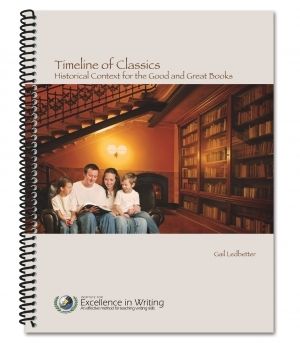
Timeline of Classics

 
 IEW Phonetic Zoo
Timeline of Classics is exactly the resource I've wished I had several different times. This spiral bound book by Gail Ledbetter contains a list of classic books that fit into different historical time periods.

Each page states a timeline date on the top right side. The chart on the page then lists a description of the book topic, the book title, the author, and the grade level the book is best suited for. Perfect for finding a book to accompany whatever history curriculum you're using, or design your own unit study.

A feature I wasn't expecting from the self-explanatory title is that each page also contains a quote from one of the books on that page, or a person that was significant to that time in history. These quotes can be used for copywork or memorization, or even a discussion starter.

We have a history curriculum, but I tend to wing it for literature in the elementary grades. Using the Timeline of Classics, I can pick classic literature to correspond with our history curriculum. I am sure I'll still be browsing the library catalog for some modern options, but the Timeline of Classics will be a go-to reference that I will use for years to come! Probably for my remaining 15 years of homeschooling!

The Timeline of Classics is available for $29.00 in physical spiral-bound form, or $19.00 as a digital download from IEW.

A Word Write Now

 IEW Phonetic Zoo A Word Write Now is so much more than just a thesaurus. Loranna Schwacofer has compiled a topical thesaurus that is helpful for writers of all ages. The word lists are categorized into 3 categories: character traits, words to describe, and words for movement and the senses. There is also an appendix that lists literary devices, transition words, and literary genres.

I like that A Word Write Now groups words into categories. It is simpler than tracking through a thesaurus from word to word until I found the one I want to use. Instead, I can look up the character trait or movement I want to describe and find a list of adjectives, adverbs, and verbs that fit that character trait. Older students can be taught to use the book independently as they write, while younger students can be helped to use it in editing a work-in-progress.

The "words to describe..." section is a little different. You can look up words to describe weather, or time, or colors. You can also look up words for speaking, so you don't just keep saying, "He said, she said."

Students who love English and reading will probably find themselves just reading through the lists, absorbing the variety of words. I know I have. It starts out by looking up a word type, and next thing you know ... you're just reading through the lists and enjoying the richness of the language. As they discover other words, they can add them to the "additional words" section of each list.

One little feature that seems to be there for the pure enjoyment of the written word is quotes and literary excerpts to accompany each list of words. These quotes are just fun to read, but they also make great material for copywork, if you use that Charlotte Mason method for developing handwriting, spelling and grammar.

I know we will use A Word Write Now for years in our junior and senior high writing lessons, as well as for my own personal writing. It is available from IEW in a spiral-bound cardstock book, for $35.00.

Teaching With Games Set

 IEW Phonetic Zoo For years I have read that games are one of the best ways to teach young children, especially the distractible, energetic, hands-on kids. I know it's true, but my brain just screams "Uncle" whenever I think of using more games. I'm not as creative as I should be, or maybe I'm just too tired.

Teaching with Games is a workshop and book written by Lori Verstegen. You can purchase the workshop on DVD with the book as an e-book on cd-rom for $29.00, or you can purchase the  spiral-bound book without the workshop videos for $19.00.

First, if you puchase the DVD/CD-Rom set, I highly recommend that you PRINT the e-book. The workshop video follows along with the e-book. Having it in front of me allowed me to read along and take notes. The 12 (or so) women that Lori is teaching in the workshop are also following along with a notebook and taking notes.

Lori doesn't just explain how to use games in a general sense, she demonstrates multiple games in the 130 minute workshop, as well as telling you how to use those ideas as jump-off points for creating your own games. The book itself is helpful, but seeing the game demonstrated is easier to understand than just reading it, even though it contains samples of the different games. (Speaking of which, the ability to print off the game samples from the cd-rom is a time-saver for actually starting to use the games.) Another reason to buy the DVD/CD-Rom set is that there is a pdf of bonus materials that doesn't come in the book itself. This includes more pre-made games for learning about alliteration, similes and metaphors.

The Teaching with Games set would be beneficial for homeschool parents, co-op teachers, Sunday School or Children's Church teachers, and school teachers. Anyone who is working with students and looking for ideas to encorporate games into their teaching. The No-Prep games are great time-fillers for fun, quick reviews. The other games require preparation, but once they're made, they can be used over and over again. Once the techniques are learned, the game variations can be used to cover a plethora of subjects.

IEW Resources

I have to confess that I only associated Institute for Excellence in Writing with their writing curriculum. I hadn't looked at their other resources, so I was pleasantly surprised by the resources we received. We were impressed by all the materials and I will be using them for years to come!

You can follow IEW online (and be better informed than I was about their new products) through social media:

April E.


IEW Review


Crew Disclaimer

Wednesday, October 21, 2015

Crew Review: Skin Clear Cream and Tansy Oil Cream from Koru Naturals

Koru Naturals Review
This is my second Koru Naturals review with the Schoolhouse Review Crew. Earlier this year, we reviewed their Emu Oil and Koolpurrie Restoring Balm.  This time, we were selected to review three Koru Naturals products: Skin Clear Cream, Manuka Honey Propolis Soap, and Emu Oil and Blue Tansy Oil Cream.


Manuka Honey Propolis Soap


 Koru Naturals Review


Let me start by telling you about our experience with the Manuka Honey & Propolis Soap. This octagonal soap was a creamy white on the bottom half and yellow on top. Like many natural soaps, it didn't lather very much, but it cleansed well. I'm speaking in past tense because we completely used it up, though it lasted longer than most bars of soap at our bathroom sink.

I have two daughters with sensitive skin. They react to most liquid soaps, and all antibacterial soaps. Their hands will turn red, sore, and scaly if they don't use gentle soaps, especially in cooler weather. I put the Honey Propolis soap out for them to use. It worked well for them, with no reactions.

I also used it to clean my face on a daily basis. Other than really stinging my eyes if I wasn't careful, it was gentle enough to use without over-drying my face. It may not be intended for facial cleansing, but it works!

Skin Clear Cream


 Koru Naturals Review

The Skin Clear Cream is wonderful! It is a thick lotion, not as thick as body butter, but creamier than most lotions. It has a light lemony scent and is very moisturizing. It only takes a couple dabs to treat your whole face. This 4 ounce tub will last a very long time.

When I used the Skin Clear Cream regularly, I did notice pimples clearing up. I also noticed that blackheads and whiteheads worked their way to the surface faster and came out more easily. It served as skin treatment and moisturizer for a month. After that, I began to notice peeling skin on my chin. I switched to using the Skin Clear Cream once a day (in the morning) and night cream at bedtime. I'm not sure if the cooler weather contributed to the peeling skin or if the Skin Clear Cream was causing the peeling.

My daughter used the Skin Clear Cream as well. She felt like it probably worked, but wasn't fond of dipping it out of the tub. She wasn't consistent with it at all.

I included a picture to help you see the consistency of the cream, as well as how little we've used in the past six weeks.


Emu Oil and Blue Tansy Oil Cream


 Koru Naturals Review


I have saved the best for last. The Emu Oil and Blue Tansy Oil Cream is my favorite. The Tansy Cream (as I call it) has a slightly thicker texture than the Skin Clear Cream. It also takes just a dab at a time and will last me a very long time. I wanted to try it because my husband and I (and even our teens) were using a different arnica cream for aches and pains. The lid doesn't advertise it, but arnica is one of the top ingredients in this cream.

I immediately began using the Blue Tansy Cream on my feet every day. I have plantar fasciitis and my feet are often throbbing by bedtime. When I first rubbed in the Tansy Cream I noticed it was very moisturizing on my calloused feet. I also noticed it had a subtle spearmintish scent rather than a strong menthol or winter mint scent as many arthritis creams do. It didn't announce itself to everyone around me.

The Tansy Cream doesn't burn or get icy cold, which can be uncomfortable if other creams are put on too heavily. Instead, a gentle warmth spreads slowly over the application area. When I rub it into my feet, they stop throbbing and the sharp, stabbing pains go away. It works great for night-time relief. I didn't notice a reduction in pain if I applied it in the morning, though.

My husband has been working on our roof, so I have rubbed it into his back at times. He seemed to appreciate it. I plan to hide it from my oldest daughter, so she won't try to take it to college with her. My feet need it too much!

Final Thoughts

I was very impressed with all of the Koru Naturals products we received. They worked well and were generously sized. I even found a new staple for my home health kit in the Blue Tansy Cream.

Each of the products (and many more) can be bought at the Koru Naturals website: Skin Clear CreamManuka Honey Propolis Soap, and Emu Oil and Blue Tansy Oil Cream.

Don't forget to follow Koru Naturals on facebook and pinterest.

April E.


Koru Naturals Review


Crew Disclaimer

Tuesday, October 20, 2015

Crew Review: The Fun Spanish from Brookdale House

 Brookdale House Review

We have never studied foreign languages in elementary school. It just wasn't on my radar, and seemed too overwhelming. When The Fun Spanish from Brookdale House became available as a Schoolhouse Crew review, I was intrigued. It seemed simple, fun, and manageable. I was sure my 9 year old daughter would love it! I was right.


 Brookdale House Review


We received the level 1 e-book, as a digital download. We had no problems downloading the e-book, even with our rural internet. Once it was saved to my computer, I printed the e-book from my home printer, then 3-hole punched it and placed it in a 3-ring binder. Yellow, to keep it fun.

When my daughter saw The Fun Spanish, she was very excited. She couldn't wait to start. Each lesson is meant to last a week (or two) and contains 5 sets of activities. Each day we cover verb conjugation, vocabulary, and translation practice. The translation practice is our favorite part. First, we translate a simple sentence. Then we get to translate a silly sentence and illustrate it.

The introduction contains a weekly lesson plan, which includes a reminder to review all the sentences each week. If you want the curriculum to last for a full year, instead of one semester, there are also alternate suggestions for adding more review and slowing the pace of the curriculum. I actually prefer the slower pace, making the lessons last for two weeks. I adapted the plan a bit, letting the material simmer for two days each week without actual review on those rest days. So we study 3 days the first week, 2 days the second week, and have a general review the last day of week 2. I just prefer a relaxed educational style at this age.

I appreciate that each day's activities are short, and not overwhelming. It completely fits with Charlotte Mason's recommended short, focused lessons so attention is learned and rewarded. The student is rewarded for the daily memorization work with the silly sentence and drawing. I admit there were days my daughter wanted to skip over the lessons to the translation, and I had to encourage her to stick to it. Overall, she enjoyed the program, though.

The focus throughout level one of The Fun Spanish is on translating from Spanish to English. The student is never asked to piece together a sentence in Spanish on their own. Instead, they learn vocabulary and verb conjugation without the pressure of building correct sentences. It's a gentle introduction to the Spanish language.

I do not consider foreign languages a necessary subject in elementary grades at all, but if you do want to introduce Spanish in the 3rd through 6th grade range, The Fun Spanish is a relaxed and fun resource. I do recommend looking up some pronunciation guides online. In addition to the difference in alphabet sounds, the Spanish language places the syllable emphasis differently than the English language. This isn't explained in The Fun Spanish, but I think it should be modeled and taught from the start of the language lessons.

The Fun Spanish is available in printed book or e-book format from Brookdale House. You can follow Brookdale House on social media, too.


April E.

 Brookdale House Review

Crew Disclaimer

Tuesday, October 13, 2015

Crew Review: FishFlix.com Living Waters DVD

FishFlix.com Review no 2


This is the second time this year that the Schoolhouse Review Crew has allowed us to review a DVD from FishFlix.com. Previously, we reviewed Exploring Ephesus from FishFlix.com. This time we were sent the documentary movie, Living Waters: Intelligent Design in the Oceans of the Earth. Our family always enjoys learning about the wonder of God's Creation, but most documentaries do not have that Intelligent Design focus. Living Waters does.


FishFlix.com Review no 2

First, I just have to say that Living Waters is beautifully filmed. The footage of the dolphins, sea turtles, Pacific salmon, and humpback whales are breathtaking. Actually, even the opening sequence of slow-motion water caught the attention of my 11 year old son from the moment it started. The animals caught the attention of both my 5 year old and my 16 year old daughters. My 5 year old wanted to watch the sea turtles over and over. My husband was as enthralled as she was, and very pleased with the entire documentary.

The movie begins by explaining the two different views of how life came to be. The Darwinian theory of natural selection and evolution is compared to the evidence of Intelligent Design throughout the movie. The documentary beautifully illustrates the way each sea animal is specifically designed for its aquatic life.

In the first section of Living Waters, we learn about the intricate nature of the dolphin's echo-location radar. The second section teaches viewers about sea turtles and the amazing internal compass and magnetic navigation system that helps them find their way from their nest to the feeding grounds and then back to the breeding ground years later. The third section discusses the Pacific salmon and their complex sense of smell, combined with magnetic navigation, that develops an internal map to lead them from the ocean, upriver, to the same spot they were born. Finally, the humpback whales and their beautiful song is discussed. Specifically, the debate over the origin of the humpback whale and the complexity of the male reproductive system.

Throughout the documentary, the amazingly complex nature of these systems is explained in detail. The fact that so many people believe these all happened through accidental mutations in just the right order to ensure the survival of these species is hard to fathom. Yet, that is what many scientists do believe and what is being taught in school. Living Waters makes the argument exceedingly well that these are all planned by Intelligent Design, a Creator who used the same navigational systems in many different animals (including the monarch butterfly, the red deer, geese, foxes, wildebeest, and hummingbirds).

Living Waters is incredibly well-made. The majority of the 68 minute movie is focused on the incredible nature of the four animals being discussed. The film footage of these beautiful animals in their natural habitats are wonderfully engaging. The computer animation footage used to show the complex nature of their bodies, their sense of smell, and their internal navigation systems are very clear and helpful. These factors all help the documentary to be enjoyable to the whole family.

The filmmakers let the animals' complex natures speak for themselves. The portion of the documentary that argue for Intelligent Design and against Darwinian evolution are brief. They manage to avoid being boring and to also keep their dignity by not falling into mudslinging tactics. Statistics, research, logic, and facts are used to show the improbability that these systems developed through accidental genetic mutation rather than by design.

Living Waters falls short of ever saying "God created the world and these animals". It uses the phrase Intelligent Design throughout the movie, to maintain its scientific focus rather than fall into a religious documentary. Intelligent Design is the name of the scientific theory that God created the world. Some of the scientists do refer to "an intelligent designer" ... and they weren't talking about ancient aliens.

This is the third film in Illustra Media's series of documentaries called The Design of Life. I would love to see the rest of the series. Living Waters is beautiful and lays out the argument for Intelligent Design with great care and respect. Its integrity and avoidance of using Scripture as evidence will help broaden its audience and its reception by skeptics.

If you have family members who are struggling to understand how Creation fits in with science, I highly recommend Living Waters and The Design of Life series. Living Waters is available from FishFlix.com for $13.99. You can also purchase the first two movies in the Design of Life series (Flight and Metamorphosis) in a combo-pack for $16.78.

FishFlix.com has many other great Christian movies, including biographies, family entertainment, documentaries, and evangelistic tools. You can follow FishFlix.com on the following social media sites:


April E.


FishFlix.com Review No 2

Crew Disclaimer